The Future of Option Trading in Europe: challenges, opportunities, and what needs to change
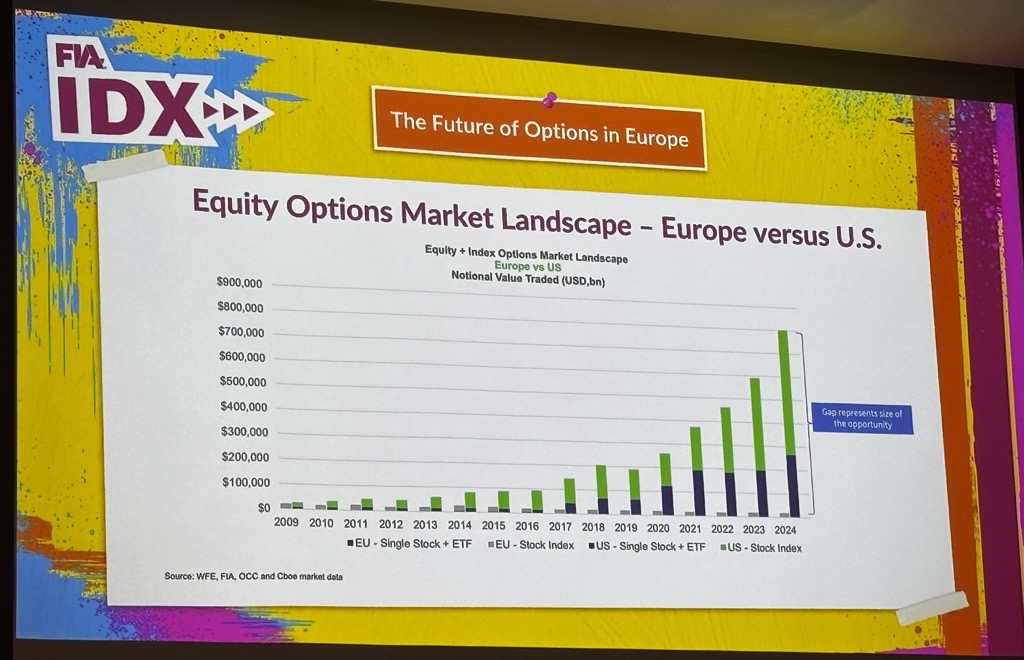
- The European options market is roughly 30 times smaller than the U.S. market, held back by cultural differences in investing, fragmented infrastructure, and inconsistent retail participation across countries.
- Despite structural challenges, European equity options volume grew over 20% year-to-date in 2025, driven in part by increasing U.S. firm interest in European risk exposure amid global asset reallocation.
- Industry leaders identified post-trade fragmentation—including the lack of cross-CCP offsets and collateral efficiency—as the primary pain point blocking deeper on-screen liquidity in Europe.
- Harmonizing contract specifications, expiry times, and trading calendars across major European exchanges such as Eurex, Euronext, and Nasdaq Europe is seen as essential to simplifying market access and improving transparency.
- Boosting retail engagement requires targeted education initiatives, the introduction of mini-options to lower notional barriers, and regulatory adjustments that balance investor protection with capital growth opportunities.
The European options market is at a pivotal crossroads. During the recent IDX London 2025 panel on The Future of Options in Europe, industry leaders discussed why the region continues to lag far behind the U.S. in both retail and institutional participation and what needs to change for Europe to unlock its full potential.

Why is Europe still behind?
Why is Europe still behind?
While U.S. options markets have grown exponentially since 2009, becoming roughly 30 times the size of their European counterparts, Europe remains fragmented both in infrastructure and investor behavior. Key takeaways:
- Cultural Differences Matter: In the U.S., a lack of government-backed pensions incentivizes personal investment. Europeans, on the other hand, often rely on structured savings and government protections, resulting in lower retail engagement.
- Fragmented Market Structure: Europe’s multiple exchanges, clearinghouses, and national regulations create inefficiencies. Unlike the U.S., which benefits from a centralized clearinghouse (OCC) and a single CSD (DTCC), Europe’s complexity drives up costs and limits liquidity.
- Retail Participation Varies Widely: In the Netherlands, retail investors drive up to 45% of options volume—thanks, in part, to a former education minister who introduced options trading into the national curriculum. Meanwhile, retail participation in France and the UK remains minimal due to regulatory barriers and limited education.
The growth opportunity is real
Despite the challenges, the European equity options market is growing, with +20% year-to-date volume growth in 2025. There is a clear appetite for European risk exposure from U.S. firms especially as global asset reallocation gains momentum.
However, infrastructure barriers are blocking the flow. As one panelist put it, “If you’re coming from the U.S. and want to build from scratch in Europe, you quickly discover how difficult it is.”
What needs to change?
1. Harmonization Across Exchanges
Differences in contract specs, expiry times, and even trading calendars between European venues (e.g., Germany, Italy, France) create unnecessary complexity. Unified specifications across exchanges like Eurex, Euronext, and Nasdaq Europe would simplify access and improve transparency.
2. Post-Trade Reform
The real “pain point” lies in post-trade fragmentation. Industry leaders called for cross-CCP offsets and collateral efficiency improvements, emphasizing that post-trade modernization is essential to unlock deeper on-screen liquidity.
3. Regulatory Adjustments
European regulators, particularly ESMA, must reconsider thresholds for block trades and trade deferrals. Higher thresholds would push more trades onto the screen, enhancing transparency and price discovery.
4. Retail Engagement Through Education and Accessibility
While retail interest exists, access remains difficult. Solutions discussed include:
- More educational initiatives in local languages.
- Launching mini-options to reduce notional barriers (e.g., LVMH, ASML, soon German stocks).
- Revisiting investment protection rules that discourage risk-taking but also limit capital growth.
A CBOE study released during IDX supports these measures and offers clear recommendations for boosting European retail options trading.
What’s next?
There’s growing consensus that now is the time to build a true European capital markets union not just in vision, but in operational reality. In the context of geopolitical shifts, rising interest in European assets, and stagnating U.S. growth, Europe must remove self-imposed structural barriers.
As panelists concluded, the opportunity is massive but coordination between exchanges, CCPs, and regulators is essential. It’s time for the industry to come together and make options trading in Europe simpler, more efficient, and more inclusive.
Looking to learn more about Listed Options Market Making?
Download our brochure.
Frequently Asked Questions
The U.S. options market is roughly 30 times the size of Europe's due to a combination of cultural differences, fragmented market infrastructure, and lower retail participation. Europe's multiple exchanges, clearinghouses, and national regulations drive up costs and limit liquidity, while cultural reliance on government-backed pensions reduces the incentive for personal investment.
The primary barriers include fragmented post-trade infrastructure, inconsistent contract specifications across exchanges, lack of cross-CCP collateral offsets, and regulatory thresholds that push trades off-screen. These structural inefficiencies increase costs, reduce liquidity, and make it difficult for both domestic and international participants to access European options markets.
Industry leaders recommend expanding educational initiatives in local languages, launching mini-options to lower notional barriers on stocks like LVMH and ASML, and revisiting overly protective investment regulations that discourage retail risk-taking. The Netherlands serves as a successful model, where options education in the national curriculum helped drive retail volumes to 45% of total options activity.
The European equity options market has seen over 20% year-to-date volume growth in 2025. There is also increasing appetite for European risk exposure from U.S. firms as global asset reallocation accelerates, though infrastructure barriers continue to limit the full potential of this growth.
Industry leaders are calling for cross-CCP offset capabilities and collateral efficiency improvements to address post-trade fragmentation, which is considered the primary pain point. Additionally, regulators like ESMA should raise thresholds for block trades and trade deferrals to push more activity onto the screen, enhancing transparency and price discovery.