The Future of Listed Derivatives Trading in Europe: challenges, opportunities and what needs to change
- The April 2025 volatility spike demonstrated that listed derivatives infrastructure has improved significantly, with liquidity recovering in days rather than months, though persistent post-trade processing failures highlighted the need for continued automation across the full trade lifecycle.
- Execution desks have evolved from isolated order-placement functions into real-time information hubs that integrate risk, margin, and settlement visibility, reflecting the full connectivity now expected between front, middle, and back offices.
- The 24/7 trading debate remains unresolved, as the industry lacks the post-trade infrastructure, liquidity provisioning, and real-time collateral movement capabilities needed to support around-the-clock listed derivatives markets.
- Listed derivatives are experiencing a renaissance driven by futurization of OTC products, retailisation through micro and mini contracts, margin optimization strategies, and intensifying exchange competition based on flexibility and cost efficiency.
- The industry's path forward depends not just on speed and technology but on building resilient, client-centric infrastructure while carefully managing the growing complexity, operational costs, and regulatory demands across the entire trade lifecycle.
The landscape of listed derivatives trading in Europe is at a turning point. The “Trader Views” session at IDX London 2025 offered a wide-ranging and candid look at how the derivatives industry is evolving. From how execution desks handled the April volatility spike to deeper questions about automation, futurization, and the rise of 24/7 trading, the discussion revealed an industry that is adapting fast—but not without growing pains.
A Real-World Test: April 2025 volatility
One of the most telling moments in recent market history was the volatility seen in April. Compared to previous high-stress events—such as in 2020 or 2022—this time the system held up better:
- Liquidity returned faster: What once took months to stabilize post-crisis now happened in days.
- Record volumes were processed: Several firms saw the highest trading days in their history.
- Operational weak spots persisted: Straight-through processing (STP) rates were high, but even a 3% failure rate across consecutive high-volume days caused stress further down the post-trade chain.
This performance showed progress—but also reminded the industry that scale and automation must continue to advance across the entire trade lifecycle.
The Front Office is now fully connected
One major theme was the integration of the front, middle, and back office. The days of execution being isolated from risk, margin, and settlement are over.
Clients now expect:
- Real-time transparency
- Faster post-trade matching
- Direct visibility into their margin and risk exposure
Execution desks are no longer just about order placement—they’ve become real-time information hubs that link technology, risk, and client experience.
Automation is growing but voice isn’t dead
One major theme was the integration of the front, middle, and back office. The days of execution being isolated from risk, margin, and settlement are over.
Clients now expect:
- Real-time transparency
- Faster post-trade matching
- Direct visibility into their margin and risk exposure
Execution desks are no longer just about order placement—they’ve become real-time information hubs that link technology, risk, and client experience.
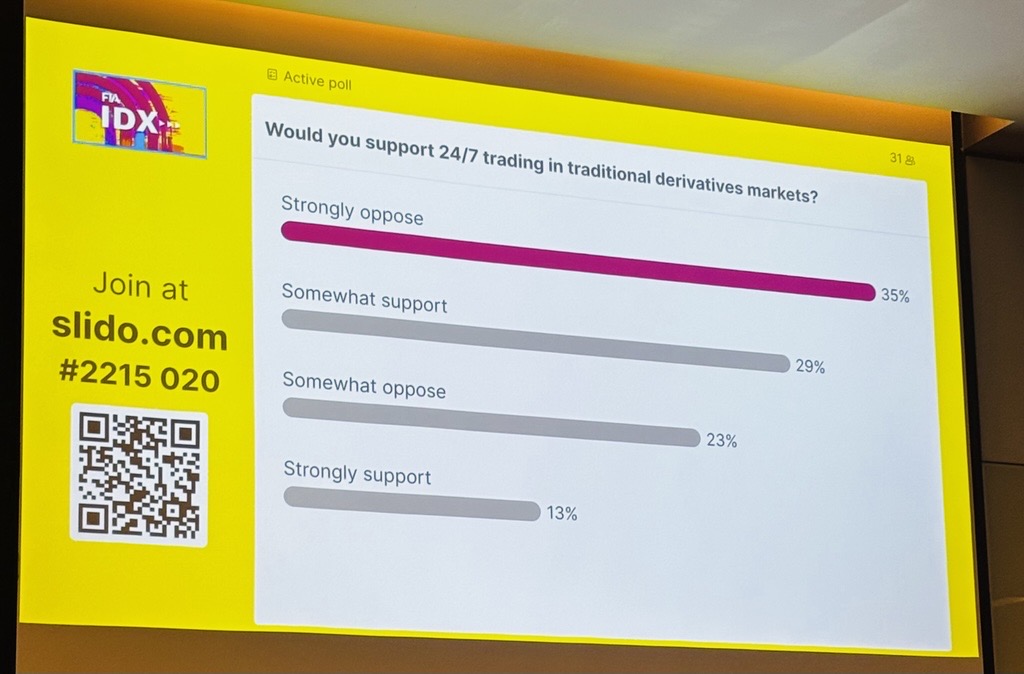
The 24/7 trading debate
One of the most debated topics was whether 24/7 trading in listed derivatives is realistic—or even desirable.
Arguments for included:
- Meeting global demand across time zones
- Keeping up with crypto-style platforms
- Making listed markets more accessible to retail investors
Arguments against highlighted:
- Liquidity gaps during off-hours that could disadvantage retail participants
- Operational cost and complexity, especially with current margining models
- Lack of infrastructure to support real-time collateral movement
The consensus? The industry isn’t there yet. Extending trading hours requires deep changes in post-trade infrastructure, liquidity provisioning, and margin workflows—not just technology tweaks.
A quiet revolution in Derivatives
Perhaps the most important insight was that listed derivatives are undergoing a renaissance:
- Futurisation is transforming previously OTC products into listed futures, from total return swaps to credit and custom baskets.
- Retailisation is bringing in a new generation of traders through micros, minis, and easier platform access.
- Margin optimisation is reshaping trading strategies and venue selection.
- Exchange competition is heating up, driven less by order book size and more by flexibility, efficiency, and cost.
What was once seen as a stable, mature segment of capital markets is now becoming a focal point for innovation.
Conclusion
The evolution of execution is about more than speed—it’s about resilience, intelligence, and client-centric infrastructure. Whether through automation, infrastructure upgrades, or product innovation, the derivatives industry is clearly moving forward.
But it must also remain cautious: growing complexity, rising operational costs, and regulatory shifts continue to demand thoughtful investment in the systems and people that make trading work—front to back.
Want to future-proof your trading operations?
Learn how our modular trading infrastructure and advanced execution tools can help you scale, innovate, and stay compliant in a fast-evolving market.
Frequently Asked Questions
Key challenges include persistent operational weak spots in post-trade processing, the complexity and cost of extending to 24/7 trading, and the need for deeper automation across the entire trade lifecycle. Rising operational costs, growing complexity, and regulatory shifts also demand continued investment in infrastructure and talent.
Markets held up better than in previous high-stress events, with liquidity returning in days rather than months and record trading volumes processed successfully. However, even a small 3% failure rate in straight-through processing across consecutive high-volume days caused significant stress in the post-trade chain.
The industry consensus is that 24/7 trading is not yet feasible. While there is demand driven by global time zones and crypto-style platforms, significant barriers remain including liquidity gaps during off-hours, high operational costs, and a lack of infrastructure to support real-time collateral movement and margining.
Futurisation is the process of transforming previously OTC (over-the-counter) products—such as total return swaps, credit instruments, and custom baskets—into listed futures. This trend is a key driver of innovation in listed derivatives, making the segment a focal point for product development and exchange competition.
Execution desks have evolved from simple order placement functions into real-time information hubs that integrate technology, risk management, and client experience. Clients now expect real-time transparency, faster post-trade matching, and direct visibility into margin and risk exposure, driving the need for full front-to-back office connectivity.