Retail Trading is reshaping Institutional Execution
Retail investors were once considered a marginal force in capital markets. Today, they are a structural component of market liquidity that institutional traders can no longer ignore.
The rise of digital trading platforms, social media communities, and accessible investment products has transformed retail participation. What began as a surge of individual investors during the pandemic has evolved into a lasting shift in how markets function.
For institutional trading desks, the implications are profound. Retail flow is influencing liquidity dynamics, execution strategies, and even the design of trading technology.
To better understand this shift, Horizon Trading Solutions surveyed 150 institutional traders at banks and brokers in the United States and the United Kingdom. The results confirm that retail trading is now embedded in institutional markets.
This article explores three key dimensions of this transformation:
- the GameStop moment that brought retail trading to the forefront
- how institutional desks have adapted their execution strategies
- the long-term impact of retail flow on market structure
The GameStop moment: when retail investors moved markets
The turning point for retail trading came in early 2021 during the now famous GameStop short squeeze.
A community of retail traders, organized primarily through online forums such as Reddit’s r/WallStreetBets, coordinated large-scale buying of heavily shorted stocks. The sudden surge in demand triggered extreme price movements and forced several hedge funds to unwind positions.
For many institutional traders, this was the first time retail investors demonstrated the ability to significantly influence market dynamics.
The event revealed several structural changes:
- retail investors could mobilize rapidly through online communities
- sentiment and narrative could drive large volumes of coordinated trading
- institutional short positions could be vulnerable to retail momentum
Although the GameStop episode was exceptional, it served as a signal of a broader transformation in market participation.
Retail traders were no longer simply passive participants in equities markets. They had become an active force capable of influencing liquidity and volatility.
Retail flow is now embedded in Institutional Trading
In the years following the GameStop episode, institutional traders began reassessing how retail participation affects execution.
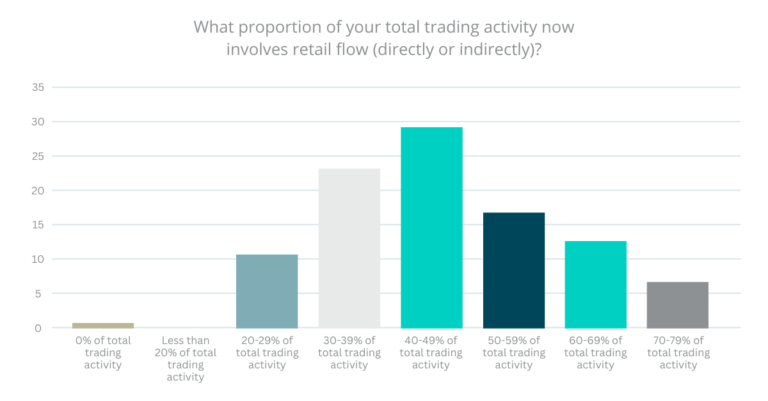
The Horizon survey highlights the scale of the shift.
Retail investors now represent approximately 20–35% of trading activity in the United States.
Even more striking is how deeply retail flow interacts with institutional trading.
Nearly two-thirds of institutional traders say retail flow now touches more than 40% of their trading activity, either directly or indirectly.
Retail orders are no longer isolated. They mix with institutional flow across multiple venues, asset classes, and execution strategies.
For trading desks, this means retail liquidity has become part of the everyday trading environment.
Why retail liquidity matters to institutional traders
Contrary to common perception, retail trading is not viewed solely as a source of volatility.
In fact, 85% of institutional traders say retail flow has a positive impact on markets.
The reason is simple: retail investors often represent natural liquidity.
Unlike market makers, who frequently hedge or offset positions within milliseconds, retail traders are more likely to hold directional positions based on investment views. This makes them genuine risk holders in the market.
For institutional execution desks, interacting with this type of liquidity can improve execution outcomes.
Retail flow can help:
- absorb institutional orders
- support price discovery
- create opportunities for better execution quality
As a result, many institutions are increasingly designing strategies to interact more effectively with retail flow.
How institutional execution strategies are adapting
The growth of retail trading has required many institutions to rethink how they approach execution.
The Horizon survey shows that nearly three-quarters of institutional traders have adjusted their execution strategies as retail activity has grown.
These adaptations include several important changes.
Smarter order routing
Execution systems are becoming more sophisticated in identifying where retail liquidity is present across trading venues. Smart order routing algorithms can fragment large institutional orders to interact with smaller retail trades.
Sentiment and alternative data signals
Retail sentiment is increasingly monitored as a market signal. Data sources such as social media discussions, online trading forums, and retail trading patterns can provide insights into potential market moves.
Liquidity fragmentation strategies
Institutions are breaking down large orders into smaller pieces to interact with retail liquidity across multiple venues and instruments.
These changes reflect a broader shift in how trading desks view retail participation: not as noise, but as a valuable source of liquidity and information.
Retail demand is shaping market structure
Retail participation is also influencing how markets evolve.
Several retail-driven trends are already beginning to reshape market infrastructure.
Extended trading hours
Retail investors increasingly expect the ability to trade outside traditional market hours. Exchanges and brokers are exploring extended or continuous trading models to meet this demand.
Fractional investing
High share prices have made fractional trading an essential feature for many retail platforms. This trend is gradually influencing how institutions interact with retail markets and how liquidity is structured.
Prediction markets and new investment products
Retail investors are increasingly interested in products that link trading to real-world events and narratives. These developments could further blur the boundaries between traditional financial markets and alternative trading environments.
For institutional participants, these trends create both opportunities and operational challenges.
The technology imperative
As retail participation continues to grow, trading technology will play a critical role in helping institutions adapt.
Execution platforms must be able to:
- handle increased retail-driven volatility
- integrate new sources of market data and sentiment signals
- manage fragmented liquidity across venues and asset classes
- automate execution strategies in increasingly continuous markets
Institutions that can effectively integrate these capabilities will be better positioned to benefit from retail-driven liquidity.
Retail trading is now a structural market force
Retail trading has evolved from a marginal market segment into a structural force shaping capital markets.
The GameStop moment revealed the power of coordinated retail participation. In the years since, institutional traders have adapted their strategies and technology to interact more effectively with retail liquidity.
Retail flow now represents a meaningful share of market activity and increasingly influences execution strategies, liquidity patterns, and market structure.
For institutional trading desks, the key question is no longer whether retail investors matter.
It is how to adapt trading technology and execution strategies to operate in markets where retail participation plays a central role.
Explore the full research
Horizon Trading Solutions surveyed 150 institutional traders in the US and UK to understand how retail trading is reshaping markets.
Download the full report to explore the data, insights, and implications for institutional trading.
Download the survey: Retail Trading, From the Fringes to the Center of Financial Markets