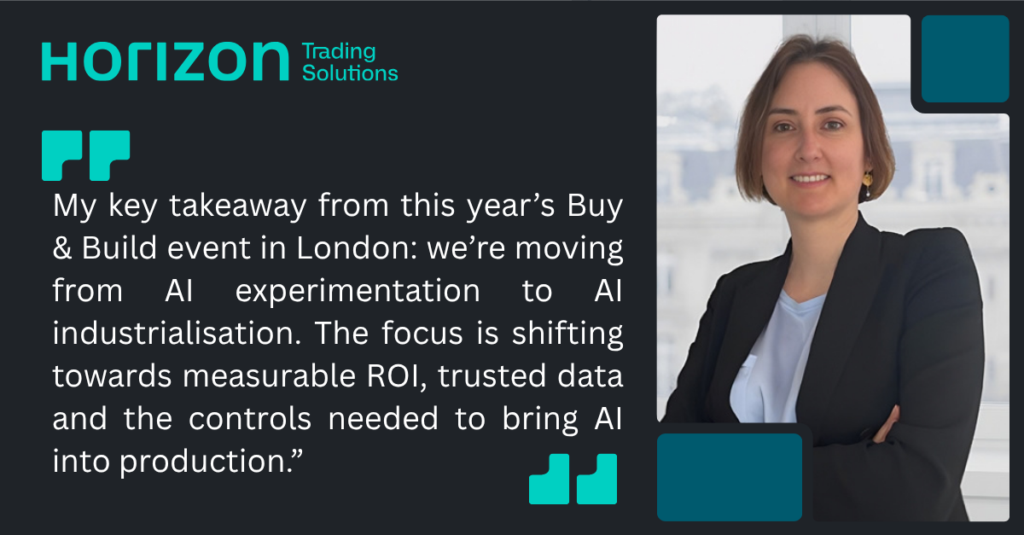
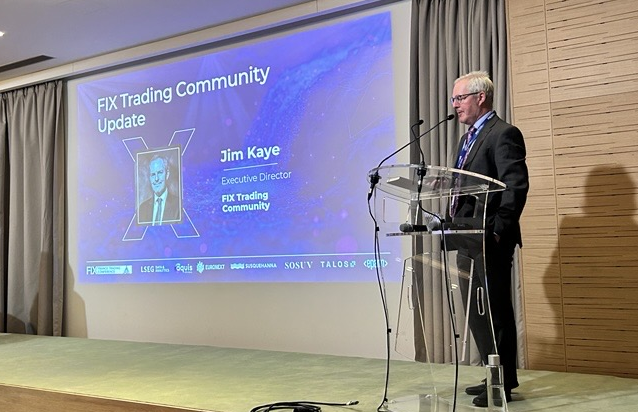
At the 2026 Buy & Build event in London, the discussions pointed to a more practical phase of AI adoption in capital markets. Identifying promising use cases remains important, but the questions are becoming more demanding: how do firms put these tools into production, govern their use and measure the value they create?
For banks and brokers, this brings the conversation directly to the Order and Execution Management System (OEMS).
An open OEMS connects order management, execution workflows and trading controls while allowing firms to integrate external tools and develop proprietary functionality. As AI becomes part of the trading workflow, that combination of integration, oversight and flexibility becomes increasingly important.
From AI use cases to measurable trading value
In our 2025 Buy & Build recap, we explored interoperability, data quality and practical AI applications, including transaction cost analysis (TCA) reports and client communications. Governance and measurable benefits were already on the agenda.
This year’s discussions placed greater emphasis on the distance between a successful experiment and a dependable production workflow.
A tool may help a developer write code faster. But if testing, integration or client onboarding remains the bottleneck, the improvement may have little effect on time to market.
The same applies on the trading desk. An AI-generated summary becomes useful when it gives the trader reliable information, in the right context, at the moment a decision is needed.
The opportunity is to connect AI capabilities to the workflows where they can deliver a measurable improvement.
What is an OEMS, and where does AI fit?
An Order and Execution Management System combines order management and execution management capabilities. It supports the progression from receiving and managing orders to routing, executing and monitoring them.
For agency trading businesses, this means supporting both high-touch activity, where traders actively manage orders, and low-touch activity, where rules and algorithms automate more of the workflow.
AI can support these activities without being given authority to execute independently. Potential applications include:
- Exception investigation: summarising an order’s history and relevant events to help a trader investigate a rejection or delay.
- Execution analysis: helping teams interpret execution data and prepare explanations for clients.
- Client service: drafting communications using authorised order and execution information.
- Development: assisting engineers with custom workflows and integrations, subject to testing and review.
These are potential integration use cases, rather than a claim that every OEMS provides them as native AI features. Their usefulness depends on the quality of the information available and the controls around its use.
Data governance starts with trading context
For AI-assisted trading workflows, data quality means more than accurate prices.
A system must also distinguish a parent order from its child orders, recognise changes and cancellations, identify the relevant client and understand which information a user is permitted to access.
Firms should establish clear requirements for:
- Consistent identifiers and timestamps across connected systems.
- The source, freshness and meaning of each dataset.
- Access permissions for users, desks and external services.
- Records of the information supplied to AI tools and any resulting actions.
An OEMS is an important source of order and execution context. Connecting it to analytics or AI services requires the same care as any other integration involving sensitive trading information.
The aim is to make useful information accessible while preserving the boundaries that govern its use.
Interoperability should preserve control
Bringing OMS and EMS capabilities together does not require every component to become inseparable.
Trading firms may use a combination of vendor platforms, proprietary algorithms, external analytics and internal risk systems. Clear interfaces help these components work together and make individual systems easier to evolve.
This matters when introducing AI. A service that reads execution data to prepare a summary has different responsibilities from a system that can submit or modify an order.
Those permissions should be explicit. Any action affecting execution should pass through the firm’s established authorisation, validation and risk controls.
Our view is that AI-assisted workflows should make information easier to use while keeping responsibility for trading actions clear.
Measure ROI across the complete workflow
A “10x” productivity claim needs a defined task, a baseline and evidence. Faster code generation does not automatically translate into faster deployment or better execution.
For an OEMS-related project, useful measures include:
Workflow | Measures to track |
Exception handling | Resolution time, manual interventions and repeat errors |
Client reporting | Preparation time, review time and corrections |
Custom development | Time from requirement to tested production release |
Desk operations | Order capacity, service levels and operational incidents |
Execution outcomes require particular care: differences in market conditions, order characteristics and trading constraints can distort comparisons.
A credible business case also includes integration, model usage, testing, oversight and ongoing support costs.
Buy the foundation. Build your differentiation.
AI-assisted development may make more bespoke projects feasible. However, owning trading technology also means maintaining connectivity, handling upgrades, supporting production and managing operational complexity.
This strengthens the case for Buy & Build: use a maintained trading platform as the foundation, then develop the workflows and execution logic that differentiate your business.
Horizon Trading Solutions’ OEMS supports high-touch and low-touch order flows, workflow automation and integration with third-party systems. Its open architecture allows brokers to adapt their trading services to their clients’ needs.
Horizon Extend provides a framework for developing custom trading logic, algorithms and integrations. It integrates with Horizon’s OEMS and Smart Order Router, with testing capabilities, monitoring, pre-trade validation and audit records.
These capabilities address a central requirement of trading technology: the ability to introduce new functionality within an established execution environment.
For Horizon, the direction is clear. Moving from AI experimentation towards industrialisation requires dependable data, controlled workflows and the freedom to build. An open OEMS helps connect those requirements to the trading desk.
Explore Horizon’s OEMS and discuss how Buy & Build can support your execution workflows.